
Chastity as seeing clearly
When you veil others, you veil yourself.

On the office floor where I used to work, I was always slipping into the pantry to make tea.
A box in the corner stocked the usual options. Generic, mass-produced, almost like office supplies: English breakfast, earl grey, mint, green tea.
Underwhelmed, I started bringing in my own: the South African rooibos tea I always ordered with my best friend at our favorite tea spot. I began always keeping a few bags tucked in my purse for exactly this purpose.
One day, as I was pouring milk into my tea, I noticed: I sure do add a lot of milk.
The more I added, the more it masked the flavor and character of the tea itself, almost even making it taste like any one of the generic teas in the pantry.
In a moment of hesitation, I wondered: do I even like this tea?
That cup of tea pointed me toward the meaning of chastity.
Yes, chastity.
Chastity is usually imagined as a cramped, negative virtue: abstinence, repression, the refusal of pleasure. It sounds thin, fearful, puritanical, societally enforced, awkward. But that’s not what chastity actually is.
Just as gluttony is not merely about food, but the corruption of consumption itself, chastity does not only concern sex, but the whole field surrounding it: desire, exposure, attention, the senses, love, dignity.
In a conversation from the Theology of the Body Institute, one of the speakers describes going on a sugar fast and hating it at first: feeling irritated and deprived.
After a few weeks, he finally permitted himself a blueberry.
It was so vivid, so sweet, that he realized— almost heartbreakingly— he had never actually tasted a blueberry before.
Once the constant sugar-coating had been stripped from his palate, he could finally taste the blueberry as it truly was. And it was far more vivid, delicate, and exquisite than he had ever known.
That is what chastity does.
It gives you your senses back. It restores your capacity to perceive reality soberly, vividly— as it actually is. Not by adding anything to it, but by removing the cheap stimulation that weakens and dulls your ability to perceive it.
It is like someone who lives with headphones in all day— podcasts, music, videos— then goes a few days in silence. At first it feels empty, almost punishing. Then he slowly begins to hear again: the hum of a room, footsteps on pavement, birds chittering, the texture of someone’s voice. His own breath. The quiet movements of his mind.
He discovers silence was never empty— only his ears were full.
This restoration does not happen automatically, however.
The speakers compare chastity to the same tradeoff required to learn the piano. Anybody can walk up to a piano and bang on the keys; anyone can “improvise.” But making music— that requires restraint, repetition, frustration, discipline, humility. Sitting at the bench learning scales. Approaching the keys slowly.
At first, that restraint feels like deprivation. You want to do what feels natural: you want to be free.
But what does freedom really look like?
It is one kind of freedom to compulsively strike at the keys however you fancy. It is another kind altogether to intimately know and soar through Chopin, Liszt, Tchaikovsky.
In other words, not every “freedom” liberates you. Many keep you trapped.
If all you see in a piano is something to bang on, then you are not actually seeing a piano. You may touch the keys a hundred times yet never draw any music out. The same way you can stand before someone and never actually meet them. Never truly know them.
Chastity is the process of wanting to know.
It is the slow discipline of becoming capable of real perception. Learning the instrument: its gradations, temperament, resonance. Learning your own force, your own hands, your own flaws. Not repressing your passions, but channeling them into something higher.
As your sensitivity deepens, the piano stops being an object you use and becomes instead a world you enter: delicate, demanding, responsive, glorious.
The piano has not changed. You have.
And so the danger of touching things coarsely is that it makes everything coarse.
Adding sugar to food overwrites its authentic flavor and makes it all taste the same: like sugar. Flooding tea with milk makes it all taste the same: like milk. Heavy makeup makes all women look the same: like makeup.
Drinking alcohol makes all people feel the same: like alcohol.
When you drink with someone, your experience of them becomes infused with alcohol’s warmth, looseness, permission, excitement. In moderation, alcohol can soften edges and dissolve inhibitions. But taken too far, it begins to dissolve the other person too: anyone can seem funny, profound, desirable. Because it’s not quite them you’re experiencing. It’s the inebriating blur.
Even an ordinary vice like resentment works this way. If you harbor resentment toward men, for example, you may begin to notice that they gradually start to resemble each other. Their motives become increasingly interchangeable. Their faces blur. The individual man vanishes beneath the category you’ve cast over him.
All of these are variations of a kind of imposed homogeneity: effacement.
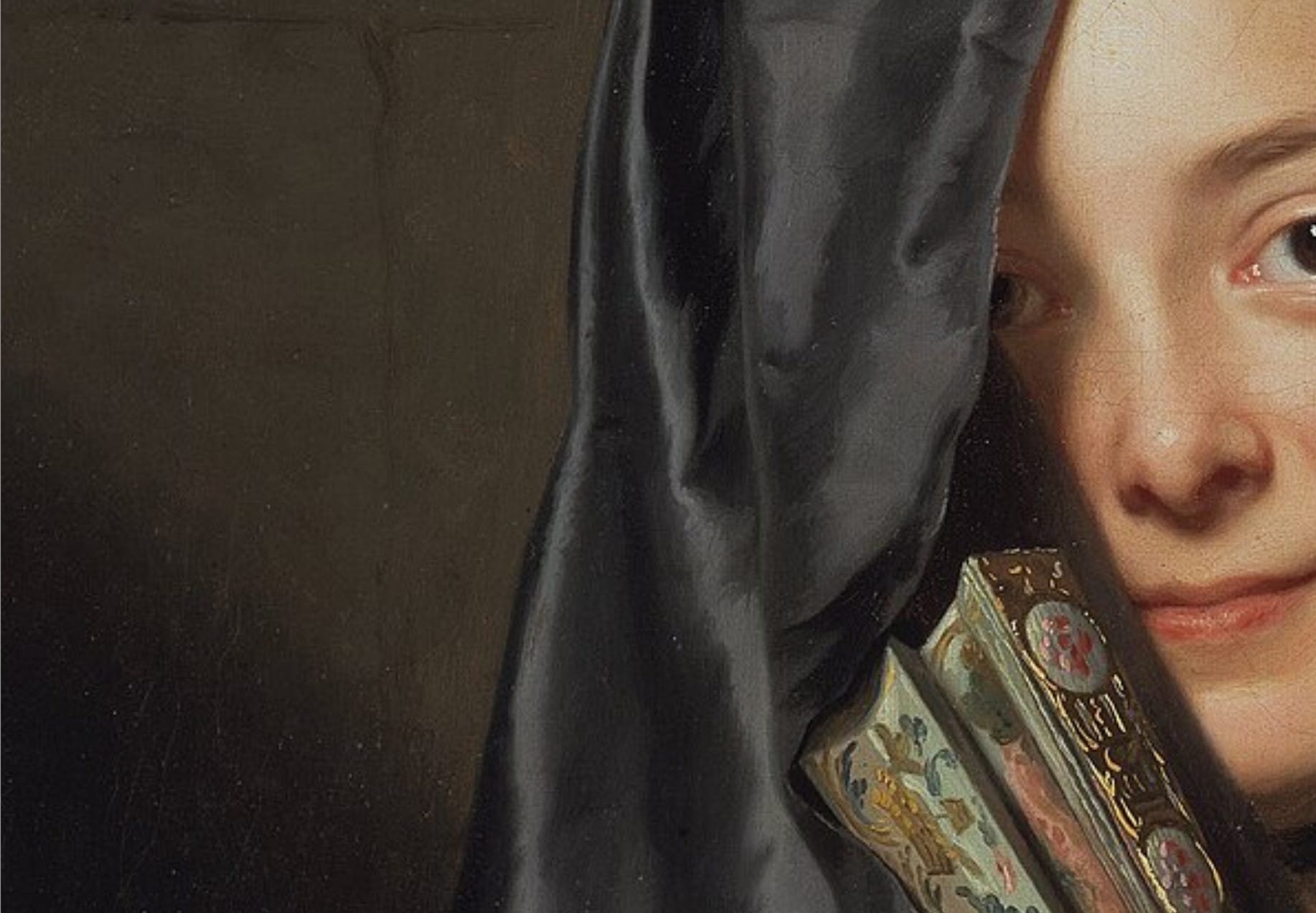
Visually, it’s like throwing everyone under the same burqa. Their identities, their particularity, their very faces, are blurred out: hidden under whatever has been imposed over them.

And so everyone in your field of vision takes on a similar appearance, blending into a sea of sameness.
The opposite extreme does the same.
Ironically, like a burqa, oversexualization also hides the face. Pornography, for example, makes the body so available, so visually loud, so unerotic, that the person behind it disappears. The body becomes vacant, interchangeable with any other.
But people, in their endless particularity, are not interchangeable. They only appear that way at a distance.
In other words, if everyone starts to look veiled to you— blurred, distant, interchangeable— then something in you has been veiled. By excess, lust, cynicism, overstimulation. Whatever lie or logismos (as the Orthodox say) has come between you and reality.
Yes, the truth is that nobody is ever covered, ever. It is you who is “wearing the burqa.” It is you who is wearing the covering over your own eyes: pulling a blanket over your head and concluding that the room has gone dark.
The world has not lost its particularity. Fruits have not lost their sweetness. People have not lost their mystery. You have just lost your capacity to perceive it.
No one sets off with the intention to become numb. It happens over time, through small, self-granted permissions. You take the parts of reality that serve you and quietly evade those that would require something of you in return. For example, indulging in analysis to feel right while avoiding any action that would reveal whether you actually are. Or indulging in connection to feel loved, yet avoiding any conflict which would reveal if you really are.
In this way, you get used to the act of looking away before the whole picture can come into view. You train yourself to see partially.
This is why the most obvious form of unchastity is also the clearest example of “looking away.” In other words, despite appearances, pornography is not “looking too much.”
In fact, all of porn depends on a silent agreement: look as much as you want— but do not look too closely.
Look at the woman. Look at the act. But do not look outside the frame.
Do not look at the lights, the camera, the men behind it. Do not think about the basic absurdity: that you are watching another man have sex with a woman. Do not wonder what had to happen for her to get here. Do not think about all the other men who are also watching this. Do not think about how she is probably dissociated. Do not think about how this is a transaction. Above all, do not think about the fact that you are using this as a substitute for actually being united with a woman you want and love.
How can the primordial act that brings forth life into the world be so emptied, so destroyed and betrayed, and for nothing?
And yet this is only the most vulgar example. Most evasions happen in ordinary daylight, in small inward moments when you cling to a self-serving image and quietly leave the fuller truth outside the “frame.” Inside that cropped frame, every vice can borrow a virtue’s name: compulsion feels like desire, laziness like peace, dishonesty like tact, cowardice like discernment.
Practiced long enough, you forget there was ever anything beyond the frame.
This is the true horror of the veil. Not that one day you commit one great sin, but that across a thousand small refusals, evasions, and lies, you train yourself into a familiar, narrow blindness. Eventually, the veil stops feeling like a veil; it feels like your own eyes.
A wall appears between you and the world, separating and numbing you from what is real.
And yet, the world keeps offering itself anyway.
The blueberry wants to be tasted for what it is. The piano wants to be played in all its dimensions. The meal wants to be savored. The person, loved. Truth, known. Life, lived.
What feels like a dimming or narrowing of the world is only the lifting of your hand to your own eyes. Chastity is the slow practice of lowering the hand, of letting the veil fall, of letting your face be seen.
Chastity, in its truest sense, is remembering that the wall was always a door. And Life is on the other side, knocking.
"It is like someone who lives with headphones in all day— podcasts, music, videos— then goes a few days in silence. At first it feels empty, almost punishing. Then he slowly begins to hear again: the hum of a room, footsteps on pavement, birds chittering, the texture of someone’s voice. His own breath. The quiet movements of his mind.
He discovers silence was never empty— only his ears were full."
Wow = the senses overwhelmed can basically end up resulting in the senses shut off. The thought that comes to mind for me is also how sin is often disobeying God by indulging in something that is adjacent to our true good (how Moses sinned when he struck the rock for water instead of speaking to it as God had instructed), or early, or in the wrong spirit (how Ananias and Sapphira gave some portion of their wealth but pretended to give it all).
Beautiful and challenging Substack, Julia!
> In this way, you get used to the act of looking away before the whole picture can come into view. You train yourself to see partially.
This helped me understand something I’d been puzzling over - why the Russian word for “chastity” is “целомудрие”: "whole-mindedness" or perhaps "attention towards the whole". So unchastity is a kind of partial attention.
"Chastity" in contrast derives either from "castus" (to cut off, separate) or "castigo" (to correct, chastise) - both focused on the negative instead of describing the positive. This feels almost as bad as "metanoia" -> "repent", why does Latin Christendom keep doing this